
- Our Services
Challenge We Tackle

You will talk to Avinash, not a sales rep.
50Cr+Ad spend managed50+Brands served7Industries - Resources
Innovative Thinking


You will talk to Avinash, not a sales rep.
The problem. Two agencies pitch you. One promises leads at two hundred rupees each. The other says four hundred. The cheaper one wins, and eight months later the business has spent less per lead and acquired fewer customers.
This happens often enough to be predictable. Cheap leads and good leads are not the same product bought at different prices. They are frequently different products entirely, and comparing them on cost per lead is comparing the wrong number.
The obvious cost is sales time spent on people who were never going to buy. The less obvious one is what that does to a sales team. Work a list where nineteen in twenty are unqualified and behaviour changes: calls get shorter, follow-up gets lazier, and genuinely good enquiries in the same list get handled with the same low expectation.
By the time anyone diagnoses this, the team has learned that marketing sends rubbish, and that belief outlasts the campaign that caused it.
It is worth being concrete, because none of these are dishonest. They are all reasonable levers that happen to trade quality for price.
Every one of these lowers cost per lead and raises cost per customer. Both movements are real, and only the first appears in a standard marketing report.
Cost per qualified lead, and beyond it, cost per customer. Neither can be calculated inside an ad platform, which is precisely why so few businesses use them.
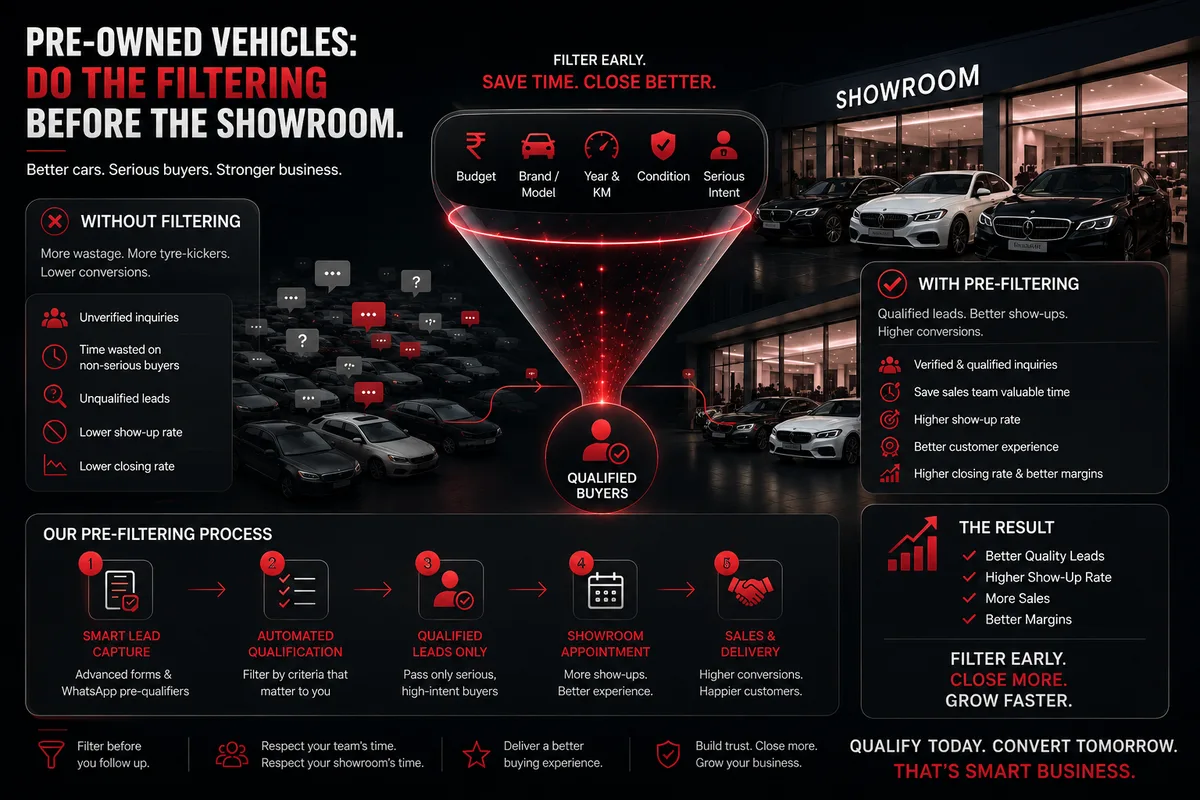
You need one thing: a status on every enquiry, set by whoever speaks to it. Qualified or not. That is the minimum viable version and it can live in a spreadsheet if it has to.
With that in place the comparison becomes trivial. Two hundred rupees a lead at a five per cent qualification rate is four thousand rupees per qualified lead. Four hundred rupees a lead at a thirty per cent qualification rate is roughly thirteen hundred. The expensive agency is three times cheaper, and no report that stops at cost per lead will ever show it.
Recording qualification is worth doing for reporting alone. Sending it back to the ad platform is worth considerably more.
When Google or Meta receives a signal that a particular enquiry turned out to be genuine, its optimisation starts targeting people who resemble real customers rather than people who resemble form-fillers. This is the single largest quality improvement available to most accounts, it costs nothing in media, and it is skipped constantly because it requires marketing and sales to agree on a definition.
Not never. If your product is genuinely low-consideration, if you have a large calling team whose time is inexpensive, or if you are building a list for a long nurture cycle where most people are not ready today, volume can be the correct strategy.
The failure is not choosing volume. It is choosing volume without deciding to, then measuring it as though you had chosen quality.
Cost per lead is the easiest number to improve and the least connected to revenue. Add one field recording whether each enquiry was qualified, judge campaigns on cost per qualified lead, and send that signal back to the platforms. Everything downstream gets easier, including the conversation with your sales team.
Our lead generation services page explains how we set this up, or tell us what your sales team says about lead quality and we will tell you what to measure first.

Question about SEO, ads or leads? Ask away.
 How can we help?Ask our assistant, or talk to a human.
AI can make mistakes. For quotes, use WhatsApp.