
- Our Services
Challenge We Tackle

You will talk to Avinash, not a sales rep.
50Cr+Ad spend managed50+Brands served7Industries - Resources
Innovative Thinking


You will talk to Avinash, not a sales rep.
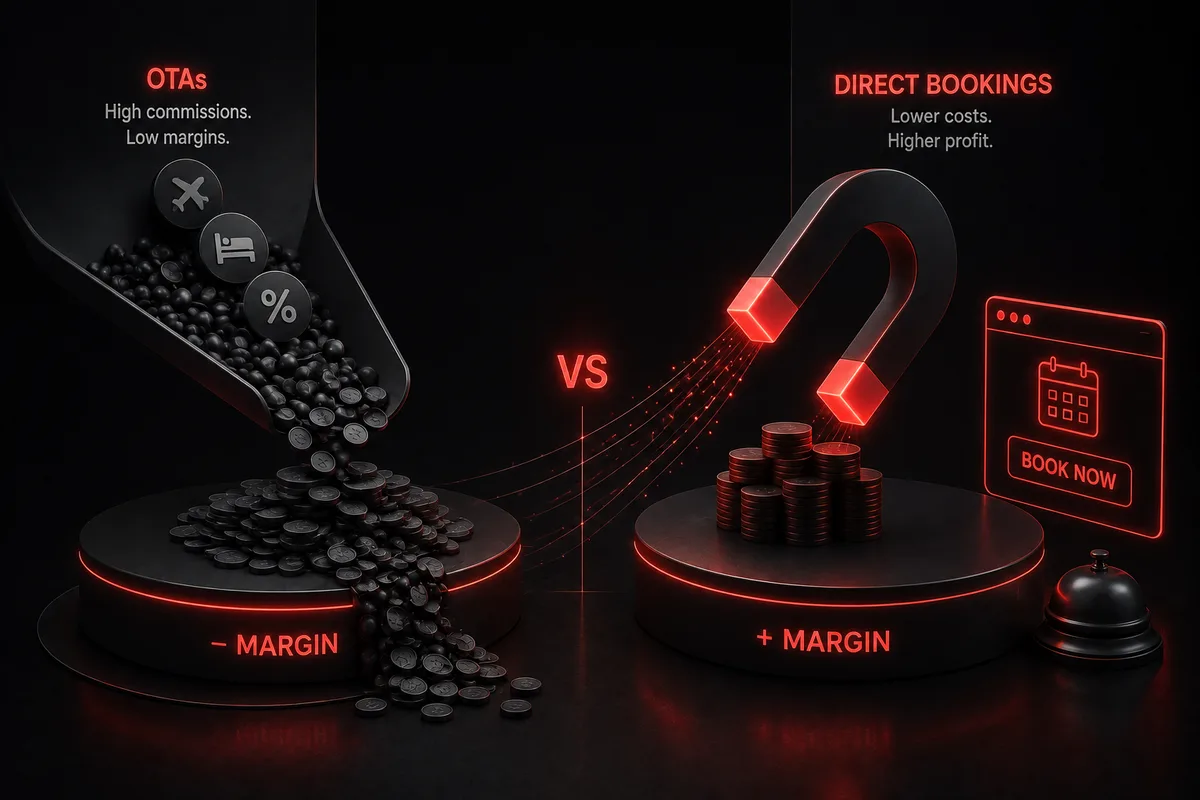
The problem. Online travel agents deliver a large share of your bookings and take a commission on every one. Everybody agrees direct bookings are better. Very few properties make meaningful progress toward them, and most attempts amount to a discount and a hopeful line on the website.
Commission is the visible cost and not the largest one. The deeper cost is that the guest belongs to the platform. You do not reliably get their contact details, you cannot easily market to them again, and the relationship you built during their stay does not accumulate anywhere you control.
Over years this is the difference between a property with an audience and one that rents its occupancy from an intermediary every season.
Worth stating plainly, because a strategy built on resentment tends to fail. They provide discovery to people who do not know you exist, trust for a traveller who has never heard your name, and a booking experience that works. That is a real service and it is reasonable that it costs something.
The aim is not to leave them. It is to stop paying commission on guests who would have come to you anyway.
A substantial share of travellers discover a property on an OTA and then search its name directly before booking. That search is the moment the commission is decided.
Two things determine what happens next. Whether your own site appears convincingly for your property name, and whether the booking experience there is at least as easy as the one they just left.
If your brand-name search shows the OTA above you, or your site takes four steps to reach a rate, you are paying commission for a booking you had almost won.
Bid on your own property name. Cheap, and it protects the highest-intent search you will ever receive. Some properties resist paying for traffic they feel entitled to. The alternative is paying a commission instead, which costs more.
Make direct visibly better, not cheaper. Rate parity agreements often restrict undercutting, and price is the weakest lever anyway. Free breakfast, late checkout, room preference, a welcome arrangement. Value the guest can see and the OTA cannot match.
Fix the booking engine. Test it on a phone. Many property booking flows are slower and less trustworthy than the OTA equivalent, and no amount of messaging overcomes that in the moment of payment.
Capture the guest during the stay. This is where the relationship is genuinely available. WiFi login, WhatsApp for service requests, a checkout message. A guest who leaves without you having their contact details is a guest you will rent again.
Then market to past guests directly. Repeat and referral bookings carry no commission at all, and past guests are the warmest audience any property has.
Not zero OTA. A property that abandons the platforms usually loses more in occupancy than it saves in commission, particularly outside peak season and particularly for first-time visitors.
The useful target is shifting the repeat and brand-search share to direct, and letting OTAs do what they are genuinely good at, which is bringing you people who had never heard of you.
Own your brand-name search, make your booking flow as good as theirs, offer value rather than a lower rate, and collect guest contact details during the stay. Keep the platforms for discovery and stop paying them for guests who already chose you.
Our travel and hospitality marketing page covers direct booking work, or tell us your direct-to-OTA split and we will tell you where the recoverable share is.

Question about SEO, ads or leads? Ask away.
 How can we help?Ask our assistant, or talk to a human.
AI can make mistakes. For quotes, use WhatsApp.