

- Our Services
Challenge We Tackle

You will talk to Avinash, not a sales rep.
50Cr+Ad spend managed50+Brands served7Industries - Resources
Innovative Thinking


You will talk to Avinash, not a sales rep.
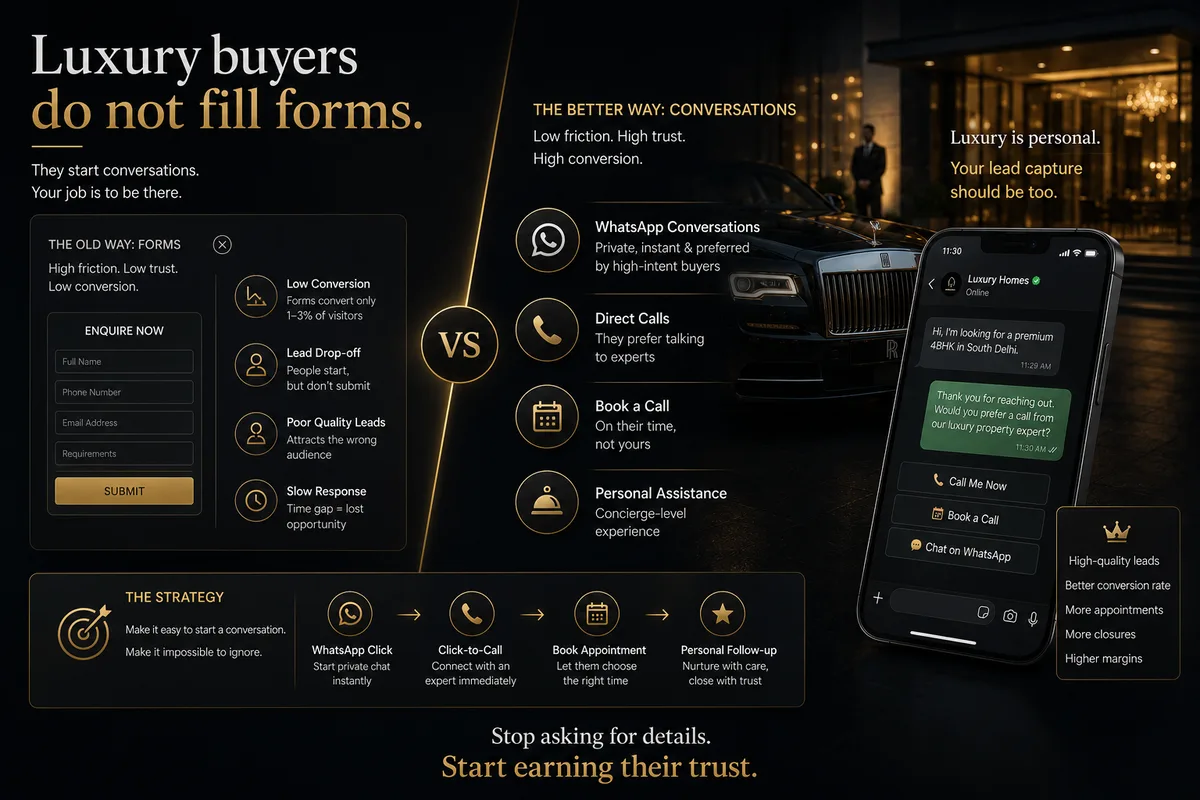
The problem. A luxury brand runs the standard playbook: lead form, instant response, follow-up sequence, cost per lead target. Volume is poor, the leads are mostly unqualified, and the conclusion is that digital does not work for premium products.
What is actually happening is that the people who can afford the product are not filling the form, and the measurement cannot see the ones who are buying.
Optimising toward form fills in a premium category selects for the wrong audience. People who complete a lead form for a high-value purchase skew toward aspirational researchers rather than buyers, so the account gets steadily better at reaching people who will never transact.
Meanwhile genuine buyers arrive through a showroom visit, a referral or a direct call, invisible to the campaign that influenced them. The channel that worked appears not to.
A buyer of a premium vehicle or a luxury service is not short of options and is not accustomed to queuing. Submitting personal details to receive a call from an unknown salesperson is a low-status transaction, and the reflex is to avoid it.
There is a privacy dimension too. Wealth attracts attention, and people at that level are more careful about where their phone number lands, not less.
So they do what feels natural. They call the showroom. They ask someone who owns one. They walk in.
Track calls properly, with call tracking that ties a phone enquiry back to its source. Most luxury advertisers do not, which is why their reporting shows a channel producing nothing while the showroom manager says the opposite.
Then record walk-ins with a simple question at reception about how they heard of you. Imperfect data that includes the real buying path beats precise data that excludes it.
Judge campaigns on showroom visits and closed sales rather than on leads, and accept that a share of influence will remain unattributable. In a category where one sale can exceed a quarter of media spend, that is a reasonable trade.
Urgency and discounting damage a premium brand in ways that are hard to reverse. A limited-time offer signals that the price was negotiable and the product is not scarce.
What works instead is craft, provenance, ownership experience and restraint. Fewer, better placements. Video that shows the object properly. And a willingness to advertise without a call to action attached to every impression, because the objective at this end of the market is to be considered, not to be clicked.
Stop optimising for form fills. Make it easy to call, message or visit, track those properly, and judge the account on showroom visits and sales. Then let the creative behave like the brand rather than like a promotion.
Our luxury and automobile marketing page covers this, or tell us how your buyers actually arrive and we will tell you what your reporting is missing.

Question about SEO, ads or leads? Ask away.
 How can we help?Ask our assistant, or talk to a human.
AI can make mistakes. For quotes, use WhatsApp.